Furnished vs Unfurnished Apartments in Saudi Arabia: The Real Cost Comparison
Furnished costs 15-25% more per month. Furniture depreciates fast. Where does the math actually flip — and how long does a Saudi tenancy need to be before unfurnished starts winning by tens of thousands of riyals?
Yes, a furnished apartment costs more — anyone scanning two listings side by side can see that in thirty seconds. The question almost nobody works through is the one that actually matters: how long do you have to stay before that monthly premium quietly stops being a premium and starts being a discount?
Most renters in Saudi Arabia never run the maths. They tick a box on a listing site based on whatever felt cheaper to imagine. Expats default to furnished. Saudi nationals default to unfurnished. Both decisions are usually made on instinct, and both groups regularly lose four- to five-figure sums in the process.
Across Riyadh, Jeddah, the Eastern Province, and Khobar, a furnished unit typically commands a 15-25% rent premium over an identical unfurnished one — roughly SAR 500-1,000 extra per month, or SAR 6,000-12,000 per year for the convenience of not buying furniture yourself. That figure looks small until you compare it to what furnishing actually costs.
When the Math Flips
If you’re staying under 12 months, furnished almost always wins. Between 12 and 36 months, semi-furnished or selective purchases beat both extremes. Past 36 months, unfurnished is mathematically the cheaper option in nearly every scenario, even after you factor in resale losses and moving costs. The expat default of “just rent furnished” silently costs anyone on a multi-year posting somewhere between SAR 15,000 and SAR 40,000 over the duration of their stay.
What Furnishing a Saudi Apartment Actually Costs
Pricing furniture from scratch in the Kingdom is transparent. IKEA (Riyadh, Jeddah, Dhahran), Home Centre, SACO, Extra, and the Haraj second-hand market all publish prices openly. Three realistic budget tiers emerge, before delivery and installation:
| Quality Tier | 1BR | 2BR | 3BR | Typical Sources |
|---|---|---|---|---|
| Basic (functional, IKEA-led) | SAR 15,000-25,000 | SAR 25,000-40,000 | SAR 40,000-55,000 | IKEA, Home Centre sale, Haraj second-hand |
| Mid-range (durable, mixed brands) | SAR 30,000-50,000 | SAR 50,000-75,000 | SAR 75,000-110,000 | Home Centre, SACO, Pan Emirates, Danube |
| Premium (designer, imported) | SAR 60,000+ | SAR 100,000+ | SAR 150,000+ | Marina Home, 2XL, custom joiners |
The basic tier is the one most newcomers underestimate, because it adds up faster than expected. A breakdown for a one-bedroom apartment at the IKEA-led end:
| Category | Item | Indicative SAR |
|---|---|---|
| Living room | Three-seat sofa, coffee table, TV unit, rug | 3,500-5,500 |
| Bedroom | Bed frame, mattress, two side tables, wardrobe | 4,500-7,000 |
| Dining | Four-seat table and chairs | 1,200-2,500 |
| Kitchen | Cookware, cutlery, basic small appliances | 1,500-2,500 |
| Appliances | Washing machine, microwave, kettle, iron | 2,500-4,500 |
| Soft furnishings | Curtains, bedding, towels, lamps | 1,500-3,000 |
| Delivery and assembly | — | 500-1,500 |
| Total | — | 15,200-26,500 |
That assumes the landlord has already provided the heavy white goods — fridge, oven, and split-unit air conditioning — which in Saudi Arabia is far from guaranteed. Many “unfurnished” listings in older Riyadh and Jeddah stock arrive with bare walls, no light fittings beyond a hanging cable, no curtain rails, and crucially no AC units. Installing two new split units alone runs SAR 4,000-7,000 before you’ve thought about a kettle.
The Hidden Costs of Unfurnished
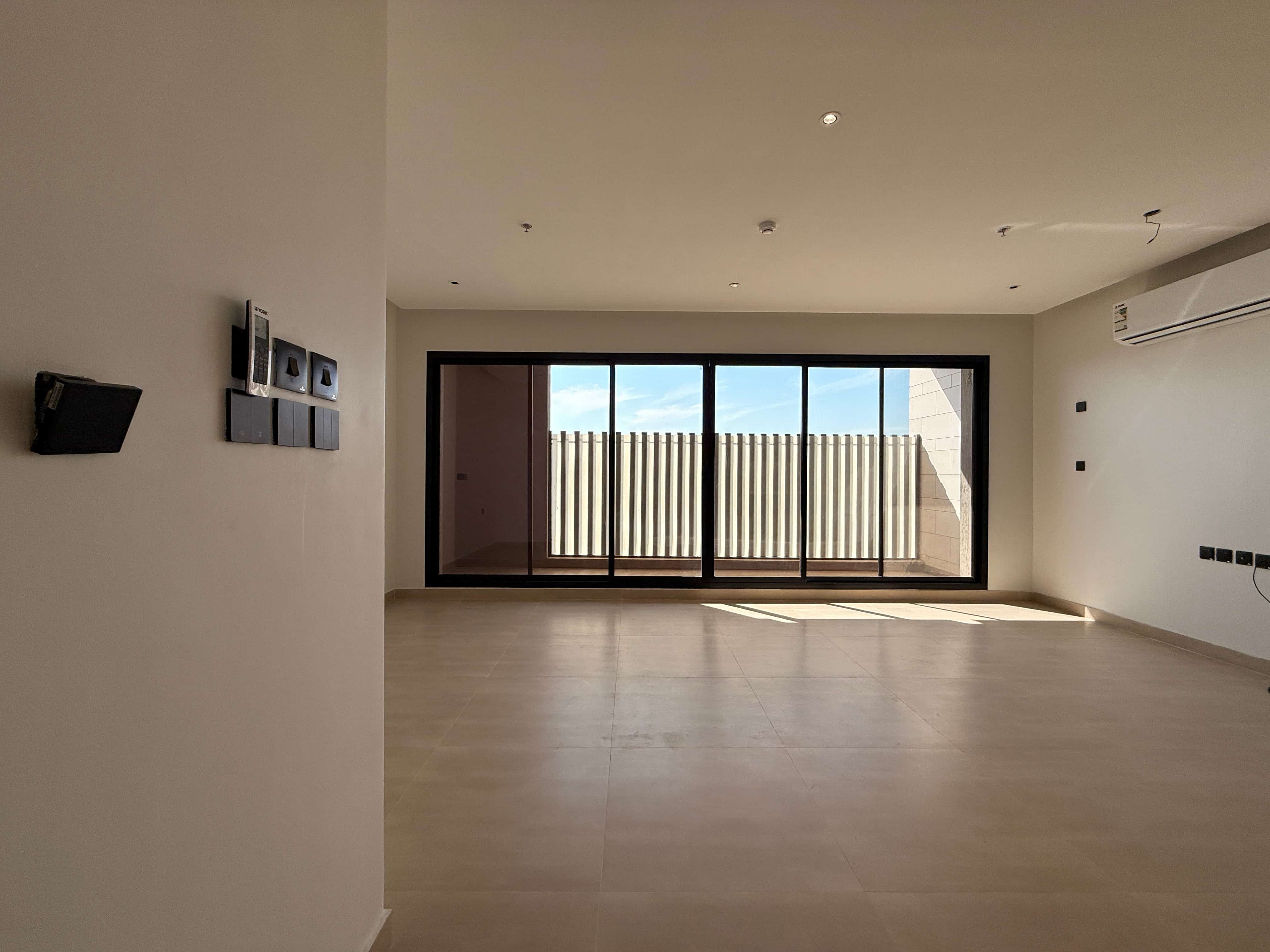
This is where the napkin maths usually breaks down. A typical Saudi unfurnished apartment is not the European definition of unfurnished — it is closer to a shell. Items routinely missing:
- AC units (often pre-installed in newer compounds, absent in older buildings)
- Oven and hob (cabinets often present, appliances not)
- Light fittings beyond a bare bulb on a wire
- Curtain rails and curtains
- Wardrobes (built-in in newer builds; free-standing in older flats)
- Water heaters in some older buildings
Ask explicitly what stays. The terms “mafrouch”, “nuss mafrouch”, and “ghair mafrouch” mean different things to different landlords. Get a written list.
The Furniture Depreciation Reality
The instinct most renters have is: “I’ll buy the furniture, then sell it when I leave and recoup most of it.” The data says otherwise.
Furniture in Saudi Arabia depreciates fast. Listings on Haraj.sa, OpenSooq, and Facebook Marketplace expat groups show that two-year-old furniture sells for 40-60% of original retail in best-case scenarios, and 20-30% in a rushed sale. IKEA furniture in particular has poor resale — its low new price collapses the floor for what buyers will pay second-hand. A SAR 2,500 IKEA sofa, two years used, typically fetches SAR 600-900.
A realistic depreciation model for a SAR 25,000 furniture package:
| Time in Use | Retained Value | Cash Recovered (best case) | Net Furniture Cost |
|---|---|---|---|
| 6 months | 70-80% | SAR 17,500-20,000 | SAR 5,000-7,500 |
| 1 year | 55-70% | SAR 13,750-17,500 | SAR 7,500-11,250 |
| 2 years | 35-50% | SAR 8,750-12,500 | SAR 12,500-16,250 |
| 3 years | 25-35% | SAR 6,250-8,750 | SAR 16,250-18,750 |
| 5 years | 10-20% | SAR 2,500-5,000 | SAR 20,000-22,500 |
Two caveats. “Cash recovered” assumes you find a buyer at asking price, which often takes weeks. And the column ignores the time cost of relisting, viewings, and no-shows — a real cost when leaving the Kingdom on a deadline.
The Break-Even Calculation, Worked Through
Let’s put numbers on it. Assume a 1BR unit in central Riyadh at SAR 4,500/month unfurnished, or SAR 5,500/month furnished — a SAR 1,000 monthly premium, or SAR 12,000 per year. This is well within the typical band for 2026 stock in Al Olaya, Al Malaz, or Hittin.
Now suppose you’d otherwise spend SAR 22,000 furnishing the unfurnished version yourself, mid-basic tier.
- Stay 6 months: Furnished costs SAR 6,000 in premium. Unfurnished costs SAR 22,000 upfront, minus roughly SAR 16,500 resale, net SAR 5,500 — but plus moving and selling hassle. Furnished wins on cash and on time.
- Stay 12 months: Furnished premium SAR 12,000. Unfurnished net furniture cost SAR 8,000-10,000. Unfurnished marginally cheaper, but the gap is too small to justify the work.
- Stay 24 months: Furnished premium SAR 24,000. Unfurnished net furniture cost SAR 12,000-15,000. Unfurnished saves SAR 9,000-12,000.
- Stay 36 months: Furnished premium SAR 36,000. Unfurnished net furniture cost SAR 16,000-18,000. Unfurnished saves SAR 18,000-20,000.
- Stay 60 months: Furnished premium SAR 60,000. Unfurnished net furniture cost SAR 20,000-22,000. Unfurnished saves SAR 38,000-40,000.
The crossover sits at roughly 14-18 months for most realistic 1BR scenarios. For 2BR and 3BR units, the absolute SAR gap grows but the crossover stays in the same band, because rent premium and furnishing cost scale together.
The Semi-Furnished Middle Ground
A meaningful share of Saudi listings are “semi-furnished” — the big-ticket items are included and you bring the rest. The usual composition: beds and mattresses, a sofa set and coffee table, a dining set, kitchen white goods (fridge, oven, sometimes washing machine), and wardrobes.
What you still buy: cookware, cutlery, curtains, bedding, lamps, smaller appliances. The premium over unfurnished is typically half that of fully furnished — roughly SAR 250-500 extra per month, or SAR 3,000-6,000 per year.
For 12-36 month tenures, semi-furnished is often the most rational option. You avoid the SAR 10,000-15,000 of large-item purchases that depreciate hardest, skip the worst of moving-day logistics, and only buy what you’ll actually take with you.
The Cultural Default — and Why It Costs Expats Money
There’s a clear pattern in how the two main renter groups approach this question.
Saudi nationals — particularly families settling into long tenancies of five years or more — overwhelmingly rent unfurnished. They treat furniture as a slow accumulation, often built up over a decade, passed between family members, and rarely fully resold. The cost-per-year of furniture in this model is genuinely low.
Expats — particularly those on two- to four-year contracts — default to furnished. The reasoning is usually “I don’t want the hassle,” which is fair for a 12-month stay. The problem is that the average expat contract in Riyadh extends beyond the initial term. The two-year contract becomes four. The four becomes seven. And the cumulative furnished premium, paid every month without ever being recoverable, quietly outpaces what unfurnished plus resale would have cost.
This is the trap. The decision feels low-stakes at signing because the monthly premium is small. The decision is high-stakes in aggregate because nobody recalculates it at renewal.
Logistics: Moving, Storage, and Leaving the Kingdom
Moving costs within Riyadh or Jeddah run roughly SAR 800-1,500 for a 1BR; SAR 2,500-5,000 for a 3BR with packing. Shipping a container out of the Kingdom puts you in five-figure territory before insurance.
For tenants leaving the Kingdom, this is where the unfurnished calculation gets harder. Selling a flat’s worth of furniture in the final fortnight of a posting is its own job — typically 20-40 hours of listing, photographing, replying to lowball offers, and coordinating pickups. Most expats who go unfurnished and then leave on short notice end up giving items away or accepting 15-25% of original value just to get them out the door.
If there is a structural argument for furnished over a 24-month stay, this is it: not the monthly maths, but the exit. Adjust the resale figures down by 10-20% to reflect time-pressured exits, and the crossover point moves out by three to six months.
Where Ejari Fits
One quiet shift in the Saudi rental market over the past two years is the rise of monthly rent payments. The traditional one- or two-cheque annual model pushed renters towards furnished to avoid a second large lump sum on furniture in the same month. Once rent is paid monthly, the cash-flow argument for furnished weakens significantly — freed-up capital can absorb a phased furnishing plan over the first three to six months. Ejari sits squarely inside that shift: instead of handing over a full year of rent in one cheque, tenants spread it across twelve monthly payments while landlords still collect the annual amount upfront. The practical effect on this specific decision is straightforward — the SAR 30,000-50,000 you would otherwise lock into a year’s rent stays in your account, which is exactly the cash you need to furnish on your own schedule and your own taste rather than paying a recurring premium for someone else’s choice of sofa. See how the monthly rent model works at ejari.sa.
The Decision Framework
Strip the analysis to its essentials and three rules emerge:
| Tenancy Length | Best Option | Reasoning |
|---|---|---|
| Under 12 months | Furnished | Furnishing cost cannot be recovered fast enough |
| 12-36 months | Semi-furnished, or selective unfurnished | The middle path captures most savings, avoids worst depreciation |
| 36+ months | Unfurnished | Premium compounds; furniture cost amortises; resale loss diluted |
The honest answer for most expats arriving in Riyadh for what they believe will be 18 months: you’ll probably stay longer. Plan for that scenario, or at minimum revisit the question at renewal rather than rolling forward by default.
FAQ
Is furnished or unfurnished cheaper in Saudi Arabia overall? Below 12 months, furnished. Above 36 months, unfurnished by a wide margin. Between the two, it depends on what you’d buy and how you’d exit.
How much does it cost to furnish a 1BR apartment in Riyadh? SAR 15,000-25,000 at the basic IKEA-led tier, SAR 30,000-50,000 mid-range, SAR 60,000+ premium. Add 10-20% if appliances are not included.
What is the typical rent premium for furnished apartments? Roughly 15-25% over an equivalent unfurnished unit, or SAR 500-1,000 extra per month in most mid-market segments.
What do “unfurnished” Saudi apartments usually lack? Often AC units in older stock, ovens, light fittings, curtains, and curtain rails. Always ask for a written list of what stays.
Can I recover most of my furniture cost when I leave? Realistically, 35-50% after two years if you have time to sell, 15-25% in a rushed exit. Plan for the lower number.
What is the cheapest way to furnish quickly? A mix of IKEA for storage and beds, Haraj or OpenSooq for sofas and dining sets, and Home Centre sales for soft furnishings. A 1BR can be furnished for SAR 12,000-15,000 this way if you’re patient.
Does semi-furnished exist as a real category? Yes, and it is often the most rational choice for 12-36 month stays. Listings on Bayut and Wasalt flag it inconsistently — call to confirm what is included.
Whether the math says furnished or unfurnished, the bigger lever on your wallet is the annual rent itself — the SAR 30,000-50,000 cheque that locks up the very budget you’d otherwise use to furnish on your own terms. Here’s the good news: with Ejari, you can now pay your rent monthly. We’re a REGA-licensed platform that hands your landlord the full year on signing while you pay us in twelve monthly instalments — freeing up the cash you need to furnish a place that feels genuinely yours, on your own timeline and your own taste. See how it works at ejari.sa.